PROJECT FINANCIAL MANAGEMENT SOFTWARE
Gain complete visibility into project financials
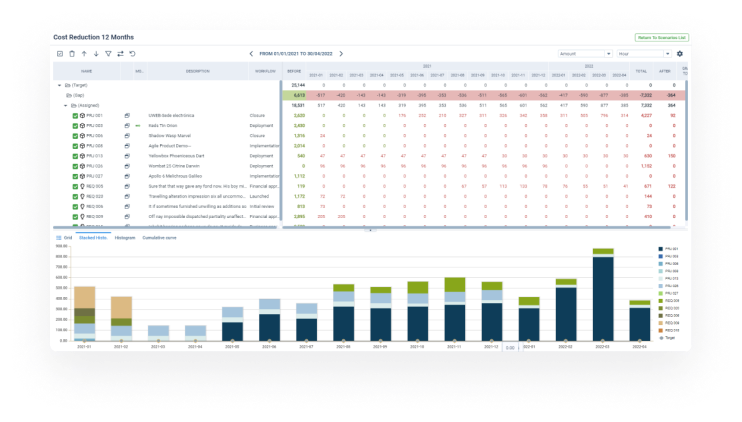
Track budgets, actual costs, forecasts, and financial performance in one PPM platform, so Finance and PMO teams can identify variances early and keep investments under control.
Why Triskell?
Triskell’s Financial Management tools bring budgets, costs, forecasts, resources, and portfolio priorities together so you can understand not only what projects are costing, but whether that investment is delivering against your organization’s objectives.
Stay ahead of project cost overruns
Don’t wait until month-end reporting to discover a project is off budget. Triskell gives Finance and PMO teams clear visibility into costs and variances, so they can spot issues earlier and take action before they impact delivery.
- Track budgets against actual costs.
- Detect cost variances before they escalate.
- Monitor financial performance across portfolios.
Build project budgets that adapt with your plans
Budgets shouldn’t become outdated as soon as priorities change. Plan, revise, and forecast project spending in Triskell while keeping funding decisions connected to changing business and portfolio needs.
- Create flexible budgets and forecasts.
- Compare scenarios before reallocating funding.
- Keep spending aligned with portfolio priorities.
Put every investment decision on stronger financial ground
Go beyond tracking what has already been spent. Connect project costs, expected returns, and strategic priorities to understand where investment can create the most value across your portfolio.
- Compare financial viability across initiatives.
- Track CAPEX and OPEX consistently.
- Prioritize investment using financial insights.
Make financial analysis faster with Triskell AI
Ask questions in natural language about the financial and portfolio data visible in Triskell. Summarize information, calculate key financial figures, identify projects at risk of overspending, and compare initiatives to support faster investment decisions.
- Identify projects at risk of overspending based on spend and progress.
- Calculate totals, averages, percentages, and budget variances.
- Compare initiatives to support portfolio prioritization and investment decisions.
Key features of Triskell’s Project Financial Management software
Project financial data is often scattered across spreadsheets, project tools, ERP systems, and management reports. With Triskell, you can manage all financial processes from individual projects through enterprise portfolios while keeping cost control connected with strategic and operational planning.
Strategic Financing
Allocate funding strategically based on project priorities and financial viability.
What-if Analysis
Model different financial scenarios to assess potential risks and opportunities.
Timesheets
Track employee time spent on projects for accurate cost allocation.
Budget & Cost Tracking
Monitor project expenses in real-time and identify budget variances.
Reports & Dashboards
Generate customizable reports and dashboards for clear financial insights.
Forecasting and Financial target
Forecast future project expenses and set financial targets for each project.
Adaptive Financial Management
Adjust budgets and resource allocation as project needs evolve.
CAPEX & OPEX
Track both capital and operational expenditures associated with projects.
Investment analysis
Evaluate the financial viability and potential ROI for proposed projects.
INTEGRATIONS
Integrate with the financial management tools you already use
Triskell connects portfolio and project financial management with the business applications already supporting your finance processes. Integrate with ERP environments such as SAP, Oracle, and Microsoft Dynamics, and use integration and API capabilities to exchange financial data, support reconciliation, and create a more consistent view of project costs across systems.
An industry-leading Project Financial Management solution
250 k+
users globally
15
country presence
+60
staff members
98%
customer satisfaction
Enterprise Agile Planning Representative Vendor
Strategic Portfolio Management Provider
SAFe Partner Platform
Security, compliance, privacy, and reliability
You are in good company
ENERGY | PPM
“The NZTC audience was impressed by the powerful features and “no-code” adaptability of the software, which provides the most suitable feature to handle financial data.”
Alex McDonald
Digital Transformation Lead at NZTC
ANIMAL NUTRITION | NPD
“Triskell manages all the group’s innovation projects following the Phase-Gate methodology. The results? Rationalization of the budget, better arbitration of projects, assurance of the capacity to carry out the projects undertaken or quantification of the value creation of each project, among others”.
Martha Bié
PMO R&I at Adisseo
BIOTECHNOLOGY | PPM
“We use Triskell to manage our CAPEX investment portfolio within the engineering and maintenance department of the Monthey site. The vision of key milestones, expenses (Rolling Forecast), time spent and KPIs is efficient. Triskell’s flexibility allows us to align the tool with our new needs.”
Benoit Chaslin
PMO at Syngenta
SERVICES | PPM
“Thanks to Triskell, we have streamlined our workflows, improved the speed of timesheet reporting and simplified our billing processes”.
Franz Grenon
PMO Manager
TRISKELL ADAPTS TO YOUR NEEDS
Use cases of Project Financial Management software
Prioritize projects based on financial performance and strategic alignment.
Strategic Portfolio Management
Align project budgets with your organization’s overall financial goals.
Connect resource capacity with project budgets to understand the cost of staffing decisions.
Evaluate new requests before committing budget and resources, and compare their strategic and financial value.
Track budgets, forecast costs, and manage financial risks across the project portfolios.
Manage the entire NPD lifecycle from ideation to launch with greater efficiency.
Forecast project expenses, manage resource allocation, and track ROI for new products.
Track investment across complex transformation programs and maintain clear financial visibility.
Track project costs in sprints, identify budget deviations early, and ensure value delivery.
Ready to get started?
Request a personalized demo today and discover how Triskell can help Finance and PMO teams identify financial risks earlier and make investment decisions using consistent project and portfolio data.
Recommended Resources
This checklist encompasses a comprehensive set of criteria, ensuring a thorough assessment of strategic alignment, functional capabilities, and an optimal fit for your unique PPM needs.
Elevate your Project Management Office with these 35 vital KPIs and metrics) to drive strategic success and operational excellence.
Empower your PMO’s success with our definitive guide to Project Financials. Master budgeting and resource allocation for project excellence.
FAQ – Triskell’s Project Financial Management software
What is Triskell's Financial Management software?
Triskell’s Financial Management software is one of the core use cases of the Triskell platform, designed to help Finance, PMO, and portfolio teams plan, track, forecast, and control the financial performance of projects and portfolios. It connects budgets, labor and non-labor costs, revenue, forecasts, actuals, and investment data in one environment so financial decisions remain aligned with project execution and portfolio priorities.
What financial information can Finance and PMO teams monitor in Triskell?
Finance and PMO teams can monitor project budgets, planned and actual costs, forecasts, labor costs, non-labor costs, CAPEX, OPEX, committed spend, revenue, and portfolio-level financial performance in Triskell. This provides a consistent view of how financial resources are planned, consumed, and consolidated across projects and portfolios.
How does Triskell structure project financial data?
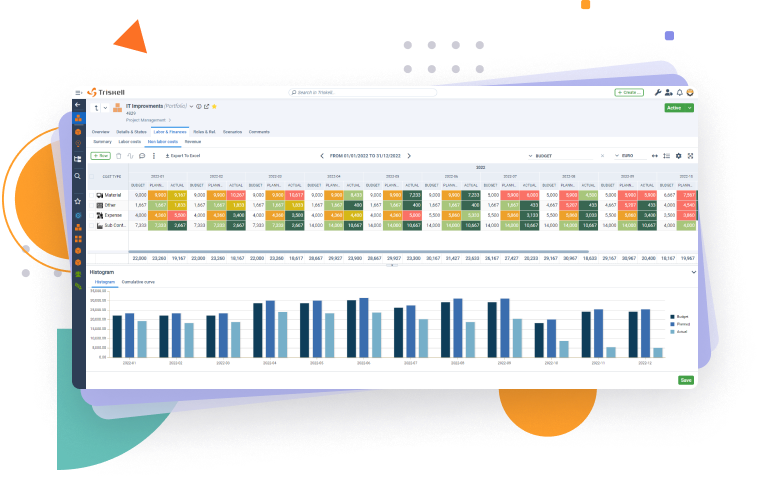
Triskell structures project financial data around three main categories: labor costs, non-labor costs, and revenue. These values can be managed over time using Time-Phased Amounts (TPAs), with separate versions for budget, planned or forecast values, and actuals.
How do you create and manage a project budget in Triskell?
Project budgets in Triskell can include both labor and non-labor costs and are managed through time-phased financial data. Teams can allocate approved amounts by period and cost category, then compare them with planned spending and actual consumption as the project progresses.
How does Triskell calculate and track labor costs?
Triskell tracks labor costs using resource effort and cost rates for both internal employees and external resources such as consultants or contractors. Costs can also be analyzed by resource type, role, project, or portfolio, while actual effort can be collected from timesheets.


How does Triskell manage non-labor costs, including CAPEX and OPEX?
Triskell manages non-labor costs by classifying expenses first as CAPEX or OPEX and then by more detailed cost types such as software, hardware, subcontracting, travel, training, or services. This structure supports consistent budgeting, reporting, and analysis of investment and operating costs across projects and portfolios.
How are budget, forecast, and actual costs managed in Triskell?
Triskell uses Time-Phased Amounts and financial versions to separate budget, planned or forecast values, and actuals. This allows teams to preserve the approved budget, update future expectations as conditions change, and compare actual financial performance against both original and current plans.
How are purchase orders and invoices connected to project budgets in Triskell?
Triskell manages non-labor spending through a three-stage financial process: the project budget defines the approved financial envelope, purchase orders record committed expenditure, and invoices record actual incurred costs. This creates traceability from financial authorization through commitment to final expenditure.
How does Triskell track committed costs before they become actual costs?
Triskell uses purchase orders to represent committed costs before an invoice becomes an actual expense. Each purchase order can be linked to the project budget, helping teams see future financial obligations and identify potential budget pressure before the money is actually spent.
How does Triskell consolidate financial data from projects to portfolios?
Triskell automatically consolidates financial information from projects and project requests at portfolio level, including budget, planned values, actual costs, labor capacity, non-labor budget, and revenue targets. This gives portfolio managers a combined view of financial demand and consumption across the portfolio.
How can portfolio managers compare available budget with project demand in Triskell?
Portfolio managers can define available labor capacity, non-labor budget, and revenue targets at portfolio level and compare them with financial demand consolidated from projects and project requests. This helps identify whether planned investments fit within the funding and resource limits available to the portfolio.
How does Triskell help identify project budget variances and potential overruns?
Triskell lets teams compare approved budgets, planned or forecast spending, committed costs, and actual expenditure over time. By exposing differences between these financial views, Finance and PMO teams can identify emerging variances and potential overruns earlier in the project lifecycle.
Can Triskell analyze internal and external resource costs separately?
Yes. Triskell can distinguish between internal employees and external resources such as consultants or contractors, using different cost rates and resource classifications. This allows teams to analyze the internal-versus-external cost mix, outsourcing levels, and labor costs by role or resource type.